Somatic Field Reports — Special Edition. Submitted ethereally.
(Ethereally, per my personal dictionary, latest entry: to float an idea into the ether with no credentials, no grant funding, and total confidence. The dictionary remains unpublished. The dictionary remains correct.)
by Jod(y)ie

No one who knows me would ever label me sensitive.
Ask around. Fifty-plus years of witnesses will testify: steady, capable, funny, tough. Runs a business. Handles things. Not a delicate bone visible from any angle.
And every word of that testimony is accurate — about the display. Because here’s the thing the committee keeps missing: detection and display are two different departments, and mine stopped speaking to each other sometime around the Eisenhower administration.
The Instrument and the Override
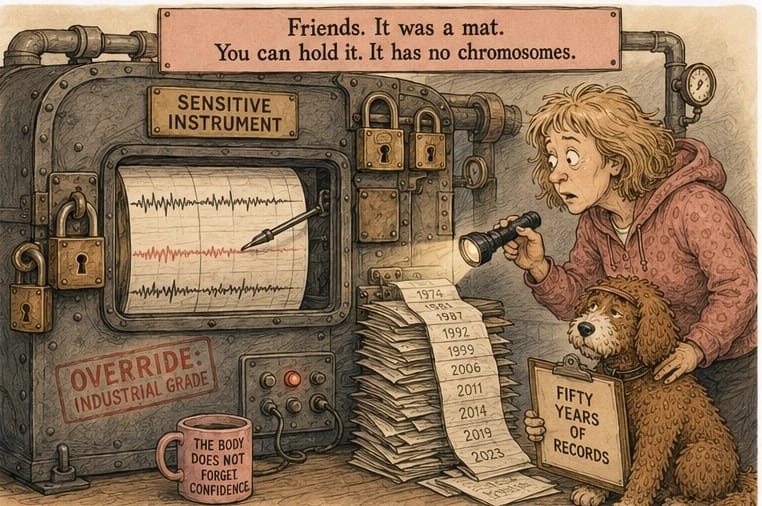
Consider what an override is actually for.
Nobody installs industrial-grade suppression on a system that isn’t detecting much. You don’t soundproof an empty room. You don’t build a dam on a dry creek. The strength of the override is a specification sheet for the instrument underneath — and mine was, as the technical literature puts it, Mary Jane strong. Pharmaceutical grade. Bootleg, home-brewed, and effective for half a century.
So when someone says “she’s not sensitive,” what they’ve actually observed is: her censoring department is exceptional. The seismograph inside was registering everything, the whole time, at full resolution. The readouts just never left the building.
The people labeled “not sensitive” are almost never the least equipped. They are the best trained.
The Training Facility
And where does training like that come from? In my lineage: a kneeling mat, and the důtky.
(Důtky — the Czech multi-strap scourge, and note the grammar: plural-only, like scissors. The language itself decided one was never enough. At our house it was pronounced dookey, because the family dictionary amends everything it touches, Webster and the old country alike.)
Czech Catholic discipline, old country to new country without losing a step. And here is the observation I’d like to enter into the record: it worked on every generation it touched. Same mat, same implement, same result — the trained non-flinch, the sealed readouts, the display department reporting “fine” on all channels. Grandparents, parents, children. Identical output, straight down the line.
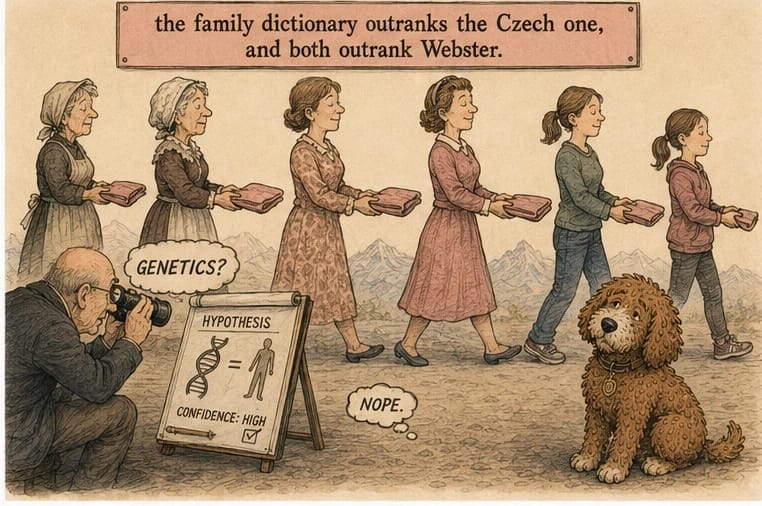
Which looks, if you’re a researcher squinting at outcomes, exactly like heredity. Runs in the family! Must be temperament. Must be genes. Must be how those people are.
Friends. It was a mat. You can hold it. It has no chromosomes.
Memo to the Committee
The nature/nurture debate has been running for roughly a century and a half, and the committee is still out, still funded, still arguing across two podiums. Meanwhile the cleanest natural experiment available — children raised inside one lineage’s conditions while carrying another lineage’s genes — sits in the gallery holding the control-group data, hand raised, largely uncalled-on.
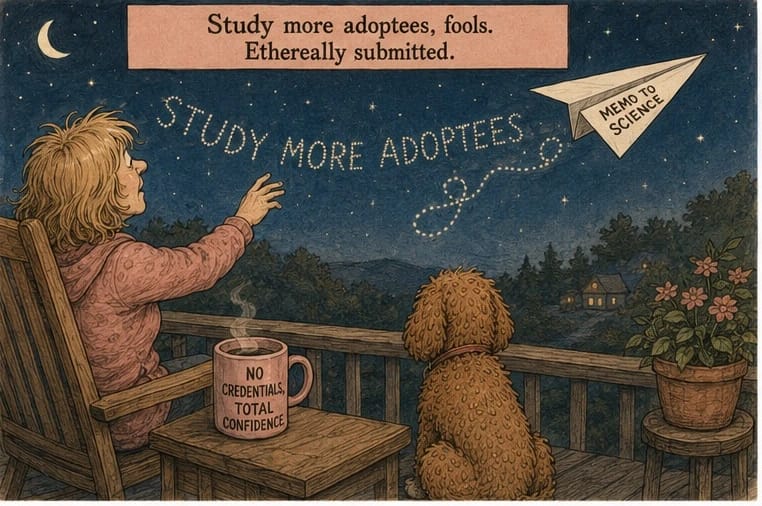
Study more adoptees, fools. Ethereally submitted.
Because what the adoption data keeps showing, and what the epigenetics people keep confirming from the other direction, is that the tidy binary dissolves on contact. Experience doesn’t just shape behavior — it chemically annotates gene expression, and some annotations travel. The mat writes in the margins, and the margins get inherited. What passes down a family line isn’t temperament or transmission, nature or nurture — it’s conditions, wearing each other’s costumes, all the way down.
I’ve spent twenty years making this exact argument about a furrier species. “It’s the breed” is the same lazy chart entry as “it’s the genes” — a way of filing the output under identity so nobody has to examine the conditions. The reactive dog isn’t expressing its pedigree. It’s expressing its load, its history, its training facility. So was everyone at my family’s table. So was I.
The Part Where I Stop Kidding (Briefly)
Here’s what the committee’s unfinished homework actually costs:
Every adult labeled “not sensitive” is a sensitive child with excellent training — and as long as we file the override under personality, nobody ever goes looking for the instrument. The person least likely to be offered gentleness is the one whose gentleness-detection was suppressed hardest. The toughest-looking one in the family is frequently the finest seismograph in the building, running fifty years of readouts no one has ever seen.
And the generational math cuts one more direction, because conditions all the way down means the hands that held the důtky were themselves outputs — trained by the same facility, one mat earlier. That’s not absolution. Harm is harm; ledgers are ledgers. But it is mechanism, and mechanism is where the inherited shame goes to die, generation by generation, whenever one member of the line finally stops grading posture and starts reading conditions.
The sensitivity was never missing. It was censored. The override was never character. It was curriculum. And the instrument underneath — patient, precise, Mary Jane strong in its own right — kept every record, waiting for the one descendant who would finally request the files.
She did. They’re extraordinary.
Filed ethereally, from an upright position. The committee may respond at its convenience; the instrument is no longer waiting on their findings. The dog, raised by neither mat nor důtky, has never suppressed anything in her life and highly recommends the lifestyle.
Continue the Field Reports
You’re at the beginning of the Somatic Field Reports: Special Editions — a six-part season on the body that keeps running the show without asking permission. This is the opening submission; the case builds from here.
- You are here: The Mat Is Not a Gene — the season opener.
- Next →: Born Sinners or Born Sensors?
- Read the whole file: the season runs through The Smoke Detector, The Thermostat Wars, and The Nala Files.
- The verdict: The Committee Responds — where the season closes and the bench turns out to be empty.
Sources & lineage
The jokes are mine; the science underneath them is not. If the “runs in the family, must be genes” story felt too tidy, here’s where the real research lives — including the part where a mat, not a chromosome, does the inheriting.
- Aron, E. N. (1996). The Highly Sensitive Person: How to Thrive When the World Overwhelms You. Broadway Books. — The instrument, described: high detection is a real, measurable trait, not a character flaw.
- Porges, S. W. (2011). The Polyvagal Theory. Norton. Available via the Polyvagal Institute. — On the gap between what the body detects and what the face is allowed to display.
- Yehuda, R., & Lehrner, A. (2018). Intergenerational transmission of trauma effects: putative role of epigenetic mechanisms. World Psychiatry, 17(3), 243–257. — How “identical output, straight down the line” gets passed on without a single gene changing hands.
- Maté, G. (2022). The Myth of Normal. Avery. — For how the training facility gets built, generation after generation, and mistaken for temperament.
The committee accepts public comment below. All submissions are reviewed by the dog.