Somatic Field Reports — Special Edition #6. The season finale. Filed ethereally, one final time — though “ethereally,” as you’ll see, has since been amended. Five memos went up. This is the report on what came down.
by Jod(y)ie
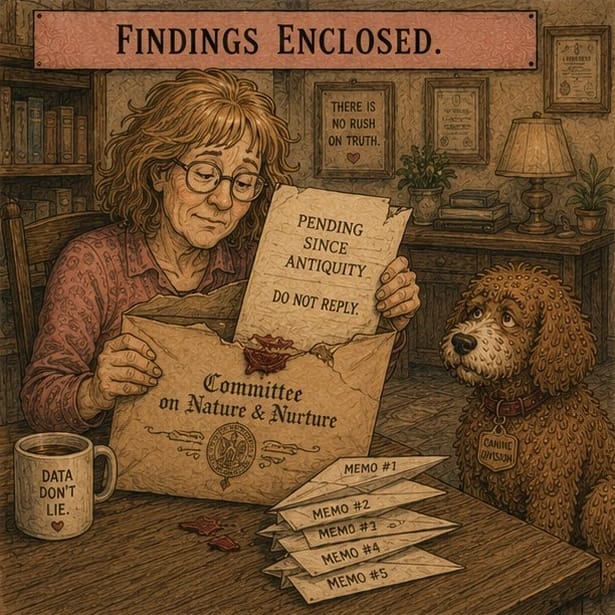
It came back.
After five paper airplanes, after two seasons, after roughly a century and a half of the debate itself — the Committee on Nature and Nurture responded. There was an actual reply. It arrived on a Tuesday, which, as we have established, means nothing except that Tuesdays keep happening.
I want to tell you what it said, and then what I found when I went to collect it in person — because the two are not the same report, and the gap between them is the whole finale.
The Reply
The envelope was heavy. Committee letterhead. A seal. The works.
Inside:
The Committee on Nature & Nurture acknowledges receipt of your submissions (5). Your inquiry has been logged and remains under active deliberation. The Committee thanks you for your patience and regrets that no findings are available at this time. Estimated resolution: pending. This matter has been pending since antiquity and is expected to remain so. Please do not reply.
I read it four times. It is, on inspection, a masterpiece — a document that manages to respond without answering, acknowledge without deciding, and thank you for a patience it fully intends to keep spending. It is the form letter the world has been mailing sensitive children for a thousand years, finally printed on paper.
And then, because I have never once in my life been able to leave a record un-read, I went to the hearing to see the deliberation for myself.
Behind the Doors
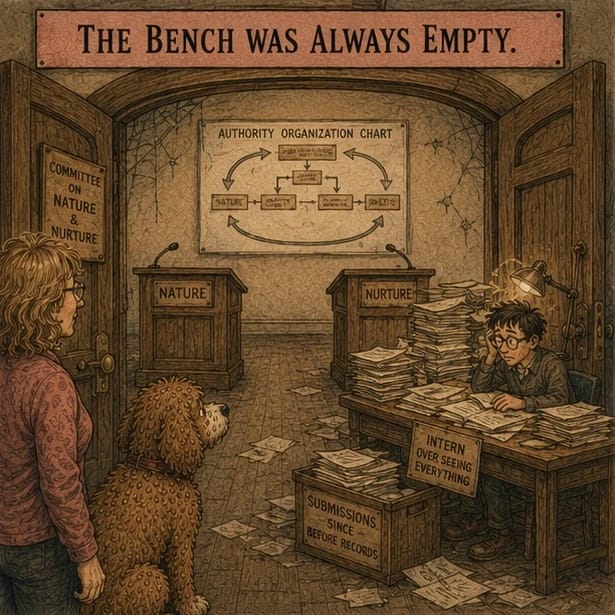
The doors are enormous. Oak, brass, the whole architecture of authority — the kind of doors built precisely so you’ll assume something important is happening on the far side, and lower your voice, and wait.
I opened them.
There is a card table. There are two podiums, marked NATURE and NURTURE, and both are empty, and have been empty long enough that the dust on them has grown its own dust. There is an org chart on the wall whose arrows, followed honestly, deliver you in a full circle back to the org chart. And there is one intern.
One. Intern. At a card table. Surrounded by a hundred and fifty years of submissions, in a room built for a tribunal, staffed by a single overwhelmed person who was handed a stamp and a mandate and no colleagues, no guidance, and — crucially — no authority to actually decide anything. When I walked in, they looked up with the face of someone who has been alone in a job much too large for one desk since before they were born.
“Are you the Committee?” I asked.
“I’m what’s here,” they said.
The Intern
I had come, I realized, to be judged. That was the whole trip. Five memos, two seasons, a lifetime — all of it a petition for a ruling. Find me guilty and let me serve it, or find me innocent and let me go, but for the love of god, rule. Enter something into the record. Close the case.
And the case could not be closed, because there was no one at the bench with the power to close it. Not out of cruelty. Not out of withholding. The intern wasn’t sitting on my verdict, savoring it — there was simply no verdict to sit on. The Committee I had been addressing my entire life, the tribunal that would finally weigh the mat and the manual and the sealed readouts and hand down a finding on whether I was defective or forgivable, had never once been in session. The bench was always empty. The doors were always just doors.
And the intern is not the villain. The intern is me, and my parents, and the parents before them: an output handed a job and a stamp and no way to author the thing everyone upstairs is waiting on. It’s interns all the way up. There is no one at the top of the building. There is only the next overwhelmed desk, and the next, and a form letter that keeps the line moving.
The Amendment
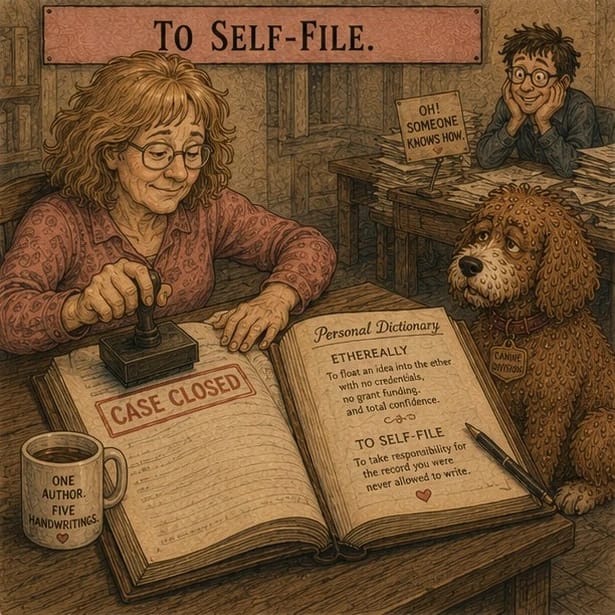
I took out the personal dictionary, right there in the doorway, and made two changes.
Ethereally, the original entry, read: to float an idea into the ether with no credentials, no grant funding, and total confidence. I let it stand. It has served.
But I added a second definition beneath it, because the word had grown while I wasn’t looking: ethereally, v. — to submit a thing to an authority you finally understand does not exist, and to discover, in the submitting, that the authority was never the point.
And then one new entry, the last this season needs:
To self-file, v. — to close your own case, from the doorway of an empty court, because you are the only officer still in the building with standing to do it.
The Part Where I Stop Kidding (Briefly)
Here is what the empty room finally taught me, and it is the whole season in one sentence: the waiting was the last override.
As long as I was waiting for the Committee to rule — to hand down the finding that would make it official that I had not been defective, that the sealing wasn’t my fault, that the instrument was always sound — I had left my own case open in a court that was never in session. I had taken the one authority that was actually mine, the only bench still staffed in the entire building, and recused myself from it, in deference to a tribunal that was always just dust and doors and a kid with a stamp.
The shame was never waiting for me to understand the mechanism. I understood the mechanism episodes ago. The shame was waiting for a conviction — and it could hold me only as long as I kept the case open, kept checking the mail, kept believing that somewhere upstairs a real authority was going to make it official, one way or the other. The verdict was never going to come. Not because they were slow. Because there was no they. And a verdict that cannot be issued is not a verdict being withheld. It’s an open door you were free to walk through the whole time, while you sat in the hall rehearsing your defense.
So I entered the finding myself. I had standing. I was, it turned out, the only one who ever did.
And the memos — five paper airplanes, thrown at a sky I thought held a committee — those were never mail. I know that now. They never reached anyone, and they worked anyway, every single time, because the lightening was never going to arrive by reply. It came from the folding. From taking the thing out of the vault, giving it a wing, and letting it leave my hands. I wasn’t petitioning. I was unpacking. The Committee was a story I needed so the unpacking would have somewhere to point.
I don’t need the story anymore. But I’ll fold one more, because there is someone out there right now with the doors still shut, still lowering their voice, still certain the tribunal is in session and the ruling is coming and the sealing was their fault. It wasn’t. It never was. The bench is empty. You have standing. Consider it entered.

Filed ethereally, from the doorway of an empty court, case closed by the only officer present. The Committee may keep its letterhead; the instrument has stopped waiting on its findings — having read them, having found them blank, having signed its own. The dog, who never had a case, never folded a memo, and never once mistook a door for a verdict, is asleep in the sun. She has been pointing at this the entire time. I finally went and sat down where she was pointing.
Continue the Field Reports
This is the finale of the Somatic Field Reports: Special Editions — a six-part season on the body that keeps running the show without asking permission. If you’ve landed here first, the whole case reads best from the beginning.
- Start here: The Mat Is Not a Gene — where the season opens, and the first memo goes up.
- ← Previous: The Nala Files
- Where it began: Born Sinners or Born Sensors? — the Committee’s original charge, before the bench turned out to be empty.
- Related: One Author, Five Handwritings — the earlier report on who’s actually holding the pen.
Sources & lineage
The jokes are mine; the science underneath them is not. The whole “nature vs. nurture” tribunal really has been in permanent recess — here’s where the actual thinking lives.
- Sapolsky, R. M. (2017). Behave: The Biology of Humans at Our Best and Worst. Penguin Press. — The definitive dismantling of the nature-vs-nurture dichotomy: it was always both, always conditions, all the way down.
- Fisher, J. (2017). Healing the Fragmented Selves of Trauma Survivors: Overcoming Internal Self-Alienation. Routledge. — For the one-author-many-handwritings problem, told with clinical precision and real tenderness.
- Perry, B. D., & Winfrey, O. (2021). What Happened to You? Conversations on Trauma, Resilience, and Healing. Flatiron Books. — The question that reframes the whole hearing: not what’s wrong with you, but what happened to you.
- Maté, G. (2022). The Myth of Normal: Trauma, Illness & Healing in a Toxic Culture. Avery. — On how the form letter gets printed in the first place, and who keeps the line moving.
The committee accepts public comment below. All submissions are reviewed by the dog.