Somatic Field Reports — Special Edition #3. Filed ethereally, from beside a heating pad.
by Jod(y)ie
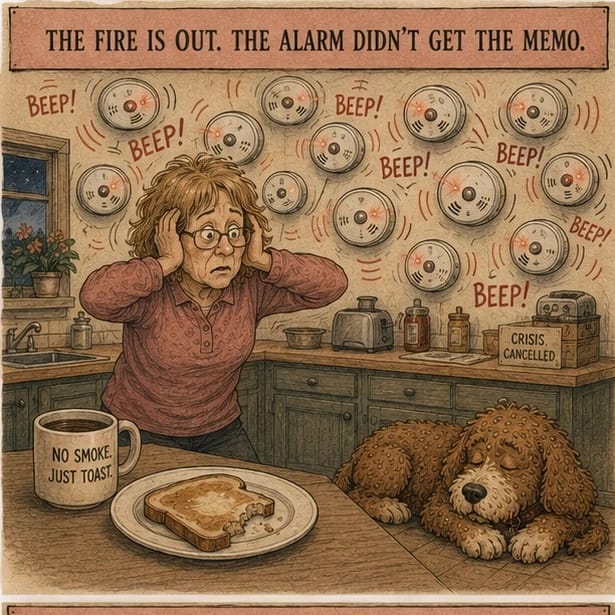
There is a smoke detector in my house that has never once been wrong about smoke. It has also never once been right about lunch, the shower, a scented candle, or the specific quality of afternoon light that it has decided, after decades of faithful service, indicates the building is on fire.
I am, of course, describing my nervous system. But you knew that.
Here is the thing about pain that outstays its welcome — the ache that lingers past the healing, the alarm that keeps sounding in a room where nothing is burning. Everyone wants to file it under one of two headings. Either it’s real, meaning there’s a fire, meaning find the fire. Or it’s not real, meaning I’m imagining it, meaning stop. And the correction committee has been squinting between those two podiums for a century, missing the third option entirely, which is the only one that has ever fit the data:
The alarm is real. The fire is out. And the device is doing exactly what it was built to do.
The Alarm That Won’t Quit
Nobody installs a smoke detector hoping it stays quiet because there’s nothing to detect. You install it because at some point, somewhere, there was smoke — and the whole point of the machine is to make very sure you never miss it again.
So it learns. That’s not a malfunction; that’s the feature. A good detector doesn’t wait for a five-alarm blaze — it fires on the first molecule, on the hint, on the thing that rhymes with the thing that once meant danger. Turn the sensitivity up high enough and it will start alarming at the memory of fire, at the shape of fire, at Tuesdays, because a Tuesday is when the fire happened and the device took notes.
Mine took excellent notes. That’s the whole problem, and it is also, on inspection, the whole point.
You Can’t Argue With a Detector

I have tried reasoning with it. This does not work, and I’d like to spare you the ladder.
You cannot stand underneath a screaming smoke detector, waving a dish towel, explaining in a calm and regulated voice that the toast is fine, actually, and expect it to be persuaded. It does not process the towel as an argument. It processes the towel as movement, and movement, to a device this committed, is simply more evidence. The harder you insist there’s no emergency, the more emergency it logs. Bracing feeds it. Fighting it is fuel.
This is the part the protocols never accounted for, the ones with the clipboards and the soft lighting: you cannot out-argue an alarm, because the alarm is not making an argument. It’s not a belief you can correct. It’s a device, running a program, and the program is older than your opinion of it.
The Service Record

So I stopped arguing and requested the logbook instead.
Decades of entries. Thousands of alarms. And here is the tell, the thing that reframed the whole file: the overwhelming majority are stamped, in retrospect, FALSE — no fire, no smoke, nothing burning. But every single one of them, every last false alarm, is also stamped, in the device’s own proud hand, BETTER SAFE.
Because look at the first entry. Look at when this thing was installed. It didn’t come with the house. It went up during an actual fire — a real one, the kind that leaves a mark — and it has been running on those original settings, at that original volume, ever since. The sensitivity isn’t a defect that appeared out of nowhere. It’s a record. Every oversensitive shriek is the device still doing, with total loyalty, the job it was assigned on the worst day it ever logged.
The alarm was never lying. It was never even wrong, exactly. It was faithful. (Faithful — per the personal dictionary, latest entry: continuing to perform a protective function long after the threat it was built for has left the building.)
The Part Where I Stop Kidding (Briefly)
Let me be precise about the claim, because it is narrower than it sounds and much kinder than either of the podiums.
Persistent pain is not imaginary. It is not weakness, it is not drama, and “it’s in your head” — as a dismissal — is a lie that has cost people years. The alarm is real. The wiring is real. The ringing is genuinely, measurably happening. What the newer readings keep showing, from the pain-science side of the building, is that a nervous system can go right on sounding the alarm long after the tissue underneath has quietly healed — not because you’re broken, but because the system is plastic, it learns, and a system that learns can learn to be afraid. An alarm can get very, very good at its job. That is not the same as there being a fire.
And here is what that means, which is the opposite of what the shame wants you to hear: the goal was never to rip the detector off the wall. A body with no alarm is not the win. Real fires still happen, and a good detector is worth keeping. The move is not to obey it — chasing every false alarm up the ladder — and not to silence it, but to do the one thing nobody offered: turn to the device that has been screaming for decades and thank it for its service. Then, gently, reach up and adjust the gain.
Because the exoneration extends here too, the way it always does. The over-vigilance was never a character flaw. It was loyalty — a protective system doing overtime on instructions issued during an emergency that ended a long time ago, on the highest authority the body had at the time, which was survival. Conditions all the way down. The alarm was never the emergency. The ringing was never the sin. And the instrument underneath it — sensitive, accurate, still faithfully on duty — was never waiting to be torn out.
It was waiting to be recalibrated.

Filed ethereally, from beside a heating pad, gain setting officially under review. The committee has still not responded to either memo; a third is being folded as we speak. The dog, whose alarms go off exclusively for genuine squirrels and stand down the instant the squirrel departs, remains the most accurately calibrated instrument in the house.
Continue the Field Reports
This dispatch is part of the Somatic Field Reports: Special Editions — a six-part season on the sensitive nervous system, read best in order.
- Start here: The Mat Is Not a Gene — the season opener.
- ← Previous: Born Sinners or Born Sensors?
- Next →: The Thermostat Wars
- Related: The Courier — more on a nervous system delivering the wrong alarm to the wrong address.
Sources & lineage
The jokes are mine; the science underneath them is not. The idea that persistent pain is a real, learnable output of a protective system — not proof of ongoing damage — comes from the pain-neuroscience and polyvagal lineage below.
- Moseley, G. L., & Butler, D. S. (2017). Explain Pain (2nd ed.). Noigroup Publications. — pain as a protective output, not a damage meter. (Meet the work at Moseley’s Tame the Beast.)
- Moseley, G. L., & Butler, D. S. (2015). Fifteen Years of Explaining Pain. The Journal of Pain, 16(9), 807–813.
- Porges, S. W. (2011). The Polyvagal Theory. W. W. Norton. — the body’s threat-detection system and neuroception. (More at Porges’ Polyvagal Institute.)
- Sapolsky, R. M. (2004). Why Zebras Don’t Get Ulcers (3rd ed.). Holt. — an alarm built for real fires, still firing when the fire is out.
The committee accepts public comment below. All submissions are reviewed by the dog.