Somatic Field Reports — Special Edition #4. Filed ethereally, from inside a personal weather system.
by Jod(y)ie
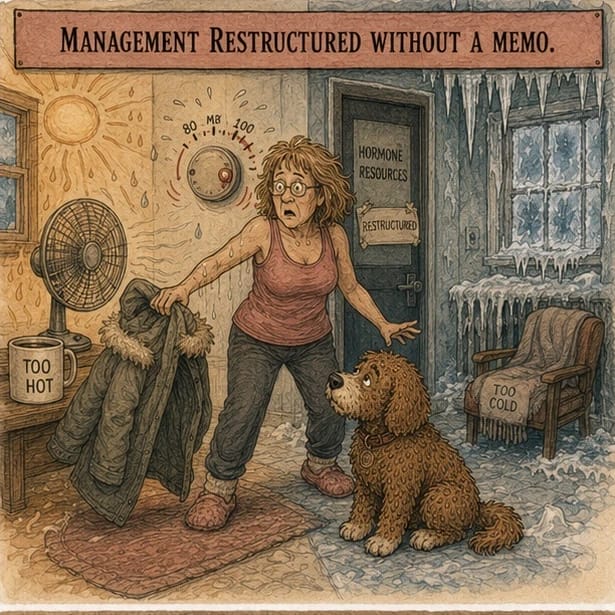
For most of my life, the building ran its own climate control and never once asked my opinion about it. The temperature simply happened — quietly, correctly, in the background — the way a well-run institution keeps the lobby comfortable without ever making the comfort your problem.
Then, sometime in the last few years, without a meeting, without a memo, without so much as a farewell email, management restructured.
The Reorg Nobody Announced
Hormone Resources — the department that had run the thermostat flawlessly for four decades — was, I have since learned, quietly dissolved. Not fired for cause. Reorganized. Sunset. Transitioned, per the language such departments use when they mean gone.
I found out the way everyone finds out about a reorg: not from an announcement, but from the sudden and total breakdown of a service I had never once had to think about. One night the building went to four hundred degrees for no reason, and then, minutes later, to the internal temperature of a meat locker. I filed a ticket. The ticket bounced. The reply, when it came, was automated:
You have reached HORMONE RESOURCES. This department has been restructured. Your inquiry is important to whoever handles it now. We do not currently know who that is. Please hold indefinitely.
The Thermostat Is Not Broken
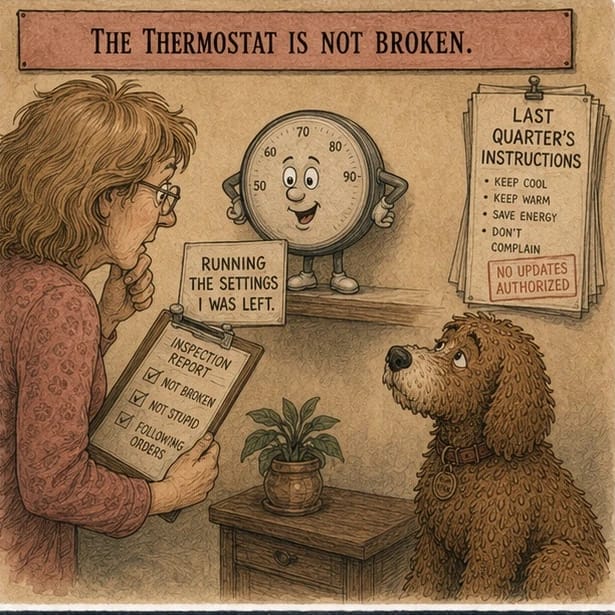
Here is what everyone gets wrong, starting with me. Everyone assumes the thermostat is broken. It is not broken. I have checked. The thermostat is one of the most competent instruments in the building, and it is doing precisely what a thermostat does: reading the settings it was given and acting on them with total conviction.
The problem is that the settings changed and nobody updated the thermostat. It is running last quarter’s instructions in this quarter’s climate, at full authority, because no one revoked its authority — they just stopped maintaining the manual it reads from.
So it improvises. The hot flash is not a malfunction; it’s a thermostat with no current documentation, running a test cycle — cranking the whole system to maximum to see if anyone upstairs is still reading the reports. Nobody is upstairs. The reports pile up. The tests continue. This is what a loyal instrument does when management vanishes: it keeps the job, even when the job no longer makes sense, because the alternative — doing nothing — was never in its programming.
Filing With a Department That No Longer Exists
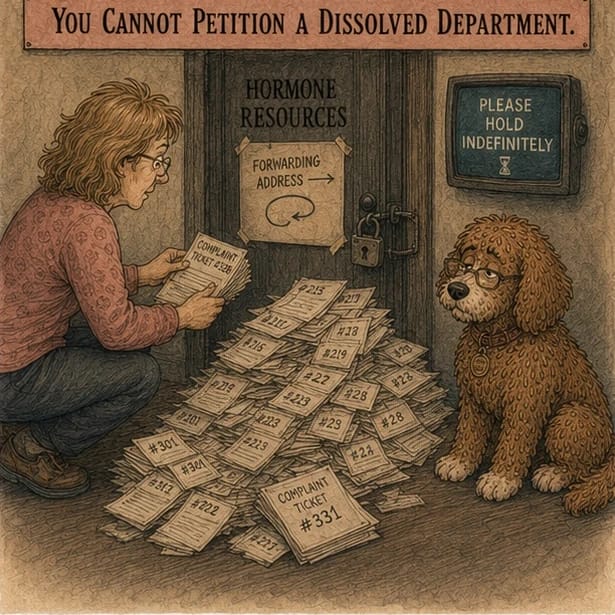
For a while, I did the thing you do. I petitioned. I sent the complaints up the chain — to the body, to the doctors, to the internet — the way you’d email building management about the lobby being an oven. Fix it. Restore service. Put it back the way it was.
But you cannot restore a department that has been dissolved. There is no one in the old office. The lights are off. The forwarding address forwards to itself. Every complaint I filed with the previous management went into a dark room, and the only thing it accomplished was to keep me convinced that someone else was still in charge of my weather.
Someone was. It just wasn’t them anymore.
The Part Where I Stop Kidding (Briefly)
Let me be precise, because the culture is extremely imprecise about this, and on purpose. The story we’re handed about this particular reorg is decline. She’s losing it. She’s falling apart. She’s not herself. Every word of that framing assumes the system is degrading — that a woman in this passage is a building with failing infrastructure, and the kindest thing to say is nothing.
But look at the actual machine. Nothing is failing. A department closed, and the instruments kept running — competently, faithfully — on the last instructions anyone bothered to leave them. That is not decline. That is a handover with no paperwork. The thermostat isn’t broken and neither am I; we are both executing flawlessly on a manual that quietly went out of print, waiting for someone with current authority to write the new settings down.
And here is the part the decline story is specifically built to keep you from noticing: there is someone with current authority. It’s you. The reorg didn’t leave the building unmanaged — it left the building to local control. Which feels, at first, exactly like abandonment, because nobody tells you the job is now yours. Nobody hands you the keys. You find them, eventually, in your own pocket, where they have been the whole time, labeled in your own handwriting.
The exoneration extends here too, the way it always does. The old management wasn’t withholding — it was also just serving its term, on instructions it inherited, until its term ended, the way every department in this body eventually hands off to the next. Conditions all the way down. Nobody broke anything. The thermostat was never the problem. The manual just ran out, mid-sentence, and left the rest of the writing to me.
(Local control — per the personal dictionary, latest entry: what’s left to you when you finally stop waiting for a department that has quietly ceased to exist.)
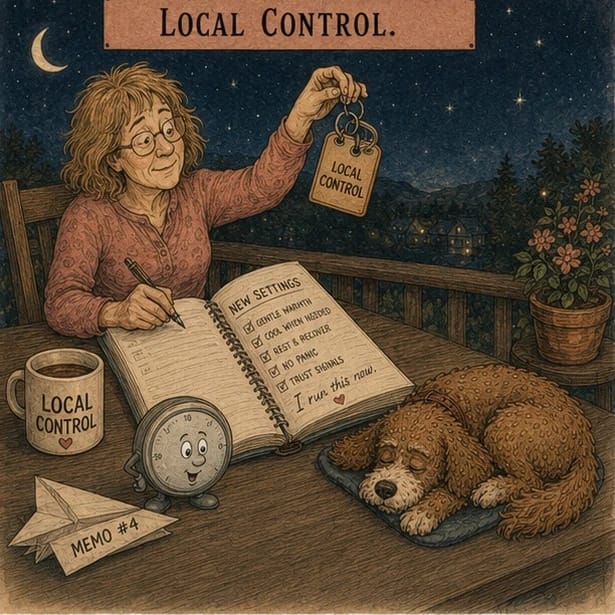
Filed ethereally, from inside a personal weather system, thermostat now under new and local management. The committee has still not responded to any memo; a fourth is folded and waiting for a clear night. The dog, who has never once been consulted about the temperature and regulates herself by the ancient method of relocating to the cool spot on the floor, remains the most sensibly governed instrument in the house.
Continue the Field Reports
This is part of the Somatic Field Reports: Special Editions — a six-part season on the body that keeps running the show without asking permission. They stand alone, but they read best in order.
- Start here: The Mat Is Not a Gene — where the season opens.
- ← Previous: The Smoke Detector Is Not the Fire
- Next →: The Nala Files
- Related: Born Sinners or Born Sensors? — another department running instructions it never wrote.
Sources & lineage
The jokes are mine; the physiology underneath them is not. If any of this reorganization felt familiar, here’s where the real science lives.
- Sapolsky, R. M. (2004). Why Zebras Don’t Get Ulcers (3rd ed.). Holt Paperbacks. — The clearest map I know of what stress hormones actually do when the department upstairs stops answering.
- Porges, S. W. (2011). The Polyvagal Theory: Neurophysiological Foundations of Emotions, Attachment, Communication, and Self-Regulation. Norton. Available via the Polyvagal Institute. — For why the body’s regulation systems keep running loyally on old instructions.
- Santoro, N., Roeca, C., Peters, B. A., & Neal-Perry, G. (2021). The Menopause Transition: Signs, Symptoms, and Management Options. Journal of Clinical Endocrinology & Metabolism, 106(1), 1–15. — The actual reorg, documented: not a failing building, a handover with no paperwork.
The committee accepts public comment below. All submissions are reviewed by the dog.