She couldn’t say it. She could tend it.
by Jod(y)ie
It’s been fourteen months. She died in May of last year, and I didn’t fall apart the way you’re supposed to. I taught a class the next day. I kept the doors open. I did what I have always done — I stayed upright.
And then, this month, I got sick.
Not a nuisance-sick. A scary-sick — the kind that lays you flat on the couch, empties your calendar, and hands you long, undefended stretches of time. And somewhere in that stretch, with my body too tired to hold the line it usually holds, she arrived. Whole. Fourteen months late, or exactly on time. I’ve stopped believing those are different things.
Because here is what I know now that I didn’t know then: a body doesn’t open the door to grief until it’s safe enough to survive what’s on the other side. I couldn’t grieve her before. I wasn’t built to hold it yet. And the thing that finally made me safe enough was the oldest, strangest safety I own —
being sick is when I got the best of my mom.
The cliché and the room
I miss my mom. Everyone says it. It’s the phrase they hand you at the funeral, the words that fit in a card. And it’s true, and it’s also fog — a sentence smooth enough to say without ever touching the thing underneath it.
What I actually miss is stranger and more specific than that. I miss a woman who could not say she loved me, and who loved me completely anyway, in a language made entirely of tending.
She was born in 1936. The Silent Generation — named, it turns out, for the exact thing that stood between us her whole life. She inherited don’t-say-it the way I inherited its opposite. I came out of the box a truth-teller. She came out of hers sworn to quiet. Two people handed opposite instruments and asked to love each other across the gap.
She is the strongest woman I have ever known. She is also the most complicated, most painful relationship of my life. Both of those are true in the same breath, and I’ve stopped trying to separate them, because the strength I admired and the silence that wounded me were the same muscle. A woman of that generation survived by not breaking. And not-breaking meant not-speaking. The thing that made her unshakable is the thing that made her unreachable in the one place I most needed to be met.
If you want the clinical word for what that builds in a child, it’s disorganized attachment — the recipe where the source of comfort is also the source of fear, where you reach and flinch in the same motion. I have spent years learning to name it. But naming it in a textbook and finding it at your mother’s bedside are different acts, and I only did the second one this month.
Here’s the mercy hidden inside the recipe, though — the part that took me fourteen months and a parasite to see:
her love had a reliable floor. She couldn’t do the ordinary daylight closeness. But drop me low enough, and she came online, whole, every single time.
The love that hid in the tending
When I was a kid, being sick was the good channel.
TV tray. A little bell set in the corner so I could ring for her — and she’d come. Flat 7-Up. Jell-O and chicken noodle soup. Vicks rubbed over my chest and dabbed under my nose. Cartoons all day long.
I remember it in that much detail because it was one of the purest transmissions of her love I ever received, and a kid built the way I was built catalogs the moments the love comes through clean. The bell wasn’t just a bell. It was proof she’d come.
And it didn’t stop when I grew up. She was best when any of us were sick or downtrodden. The distress signal was the one frequency the silence could never jam. Some parents are wonderful in the sunshine and gone in the dark. Mine was best in the dark.
Once — I was fresh out of treatment, living in my car, about as far down as a person gets — she came and stayed a few days. She washed every piece of clothing I owned. And then she ironed every last one. You don’t iron to clean; the washing already did that. You iron to restore. She was taking the wardrobe of a daughter the world had knocked down to nothing and pressing every item back into dignity, one seam at a time. Smoothing out the car, the collapse, the shame — item by item, for hours.
That was an I love you the length of an entire wardrobe, spoken without a single word.
Someone once told that story back to me as if I’d been spoiled. As if there were something soft or undeserved in a grown woman having her mother do her laundry. They couldn’t see it, because they’d never been in the car. I wasn’t spoiled. I was retrieved.
The venue was the vice
There’s a harder version of the same truth, and I’m the truth-teller, so I’ll tell it.
My brother had his bar. I had my table. Ours was a family that couldn’t do closeness in the ordinary daylight — but we could do it at the venue. The vice was the room where being together didn’t require any of the words we didn’t have. You didn’t have to break the silence. You just had to sit beside each other while the game did the talking.
So in my twenties she’d come to the casino with me, back when it was still a social thing, back when I was a young account executive quietly pulling six figures in tech with a GED and a past I carried entirely alone. Nobody in that room knew who I was. Except her. She’d play the nickel slots for hours she didn’t care about, just to be twenty feet from me while I ran the blackjack table.
When I was ahead, I’d hand her my chips to hold. In a room full of strangers, the safe holder was her. Give me the precious thing. I’ll keep it safe. I’ll be here when you come back. Same gesture as the iron. Same gesture as the bell.
And she’d try — gently, in the only way the silence allowed — to get me to leave while I was still ahead. Before I came back to her for the chips because I’d run out at the table. She couldn’t say baby, this is hurting you, please stop. The generation didn’t give her those words. So she said it sideways: let’s go home now, while it’s good.
She saw the cascade before it completed. She was reading me accurately — trying to interrupt the pattern before it hurt me — which is the exact thing I would spend my whole life doing to everyone else. I couldn’t hear her. The pull was louder than the door. She stayed anyway. Held the chips anyway. Kept trying anyway.
She got the seeing from somewhere. Or I got it from her.
The little ones
And then there was the one place that was never a side door at all.
Every other venue we had was compromised. The sick-day needed me down. The casino needed the losing. Her best tending needed a crisis to unlock it. Love that could only come through when something was wrong.
But the little ones — that was clean.
It started in a church pew. Church was her place, the one she loved, the one I didn’t want to go to — her sanctuary, the room that required silence, the exact conditions that shut us down everywhere else. And then a baby would appear on the pew in front of us, and both of us came alive.
The silence was required. But the play seeped out anyway — right through it. I’d make a silly face to crack the baby’s smile. I’d glance over to catch the joy spreading across her face. She’d stick out her tongue with a giggle she had to swallow, there in the quiet. The baby would erupt. And there we’d be — two women with our hands clapped over our mouths, eyes huge with playful surprise, giggling underneath the silence we weren’t allowed to break.
That’s the whole relationship, redeemed, in a single pew. The silence that stood between us our entire lives — and the love finding the one crack it couldn’t close. The baby was the interpreter. Everything we couldn’t say in words, we said through the little one.
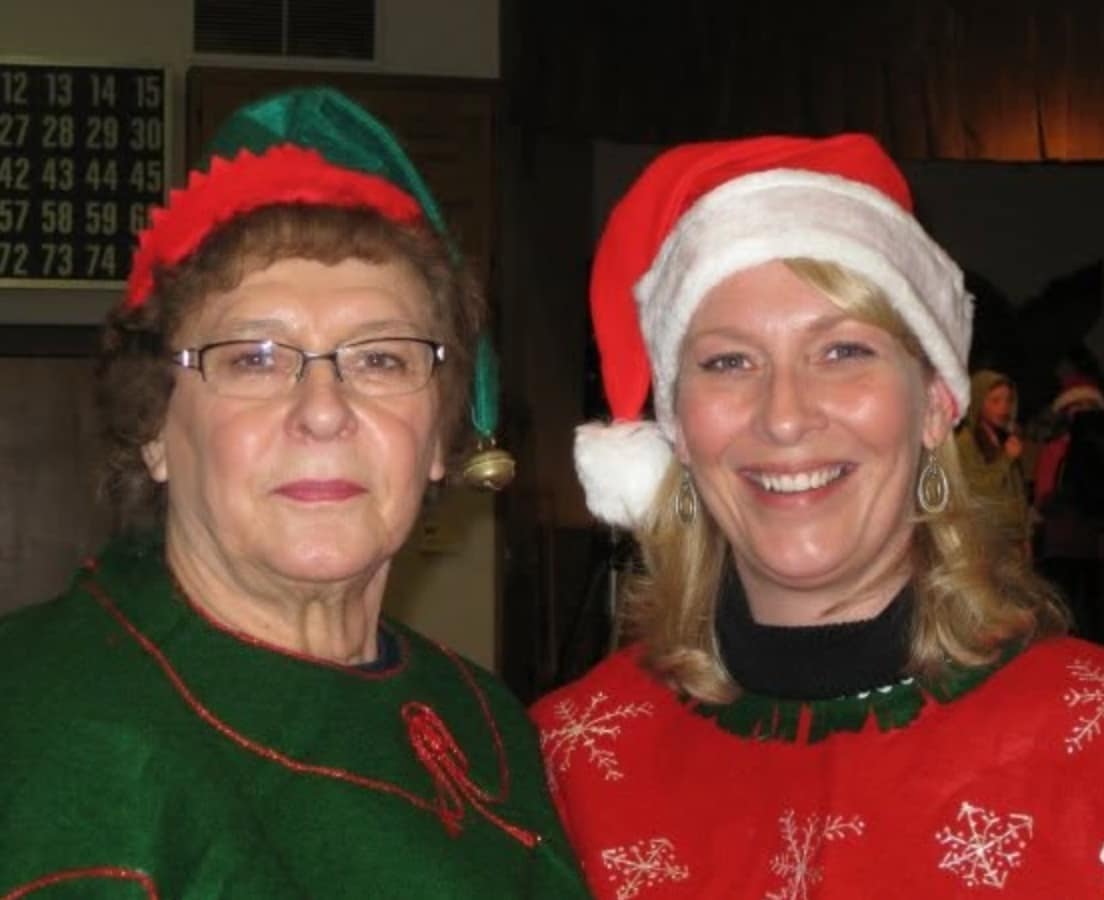
We made a ritual of it. The Eagles Club Christmas parties, the two of us dressed up as Santa’s helpers, elf hats and all, in service of children’s joy. There’s a photo of her in a green elf hat with a jingle bell dangling by her cheek — and it’s not the guarded, proud mother, and it’s not the soft one either. It’s a third mom. The playful one.

Look at the bell on that hat. The same object from the corner of my sick-room — the one I’d ring to call her — worn now on her own head, as play. She put the bell on and went to make children laugh, with me right beside her.
And then, decades later, the little ones came in on four legs.

That’s my Nala, as a puppy, held up to her cheek in the last chapter. Same lit-up face she wore in the pew. She’d lean out of her recliner to play tug — a woman in her final years, medical pendant around her neck, playing. Me with my arm around her, both of us tilted toward the small warm thing between us. Completely met.
I built my whole life on the little ones. On play as the foundation of every bond that matters. On dogs — the one species that never got the memo their own body was untrustworthy. I thought that was my calling, separate from her.
It was never separate from her. My life’s work is the grown-up form of two women making a baby laugh in a church pew. I didn’t just inherit her strength. I inherited her play — the swallowed giggle, the stuck-out tongue, the elf hat she was willing to wear. Everything I do now is that giggle, finally allowed to be loud.
I went anyway
Three years before she died, I got the news that she was in the hospital. We hadn’t spoken or seen each other in eight years.
I went to her that day, and I kept going, every day. My brother stood at the door and called me the one who’d abandoned them both. I went anyway. Past the eight years, past every reason a sensible person would have stayed away. I didn’t go to be forgiven and I didn’t go to explain myself. I went because she was down — and down was the one frequency the silence between us had never been able to jam. Her whole life she came when I was low. When she was finally the one laid flat, I came.
I didn’t come empty-handed. I came with photographs, lotion, flowers, and lipstick.
She never went a day of her life without lotioning head to toe — that discipline, that refusal to be seen undignified. So when she couldn’t do it herself, I did it for her. Head to toe. I combed and styled her hair. I put on her lipstick. I restored her into the proud woman she was, one small gesture at a time.
I ironed her. The same love she once pressed into my wardrobe, seam by seam, I gave back to her.
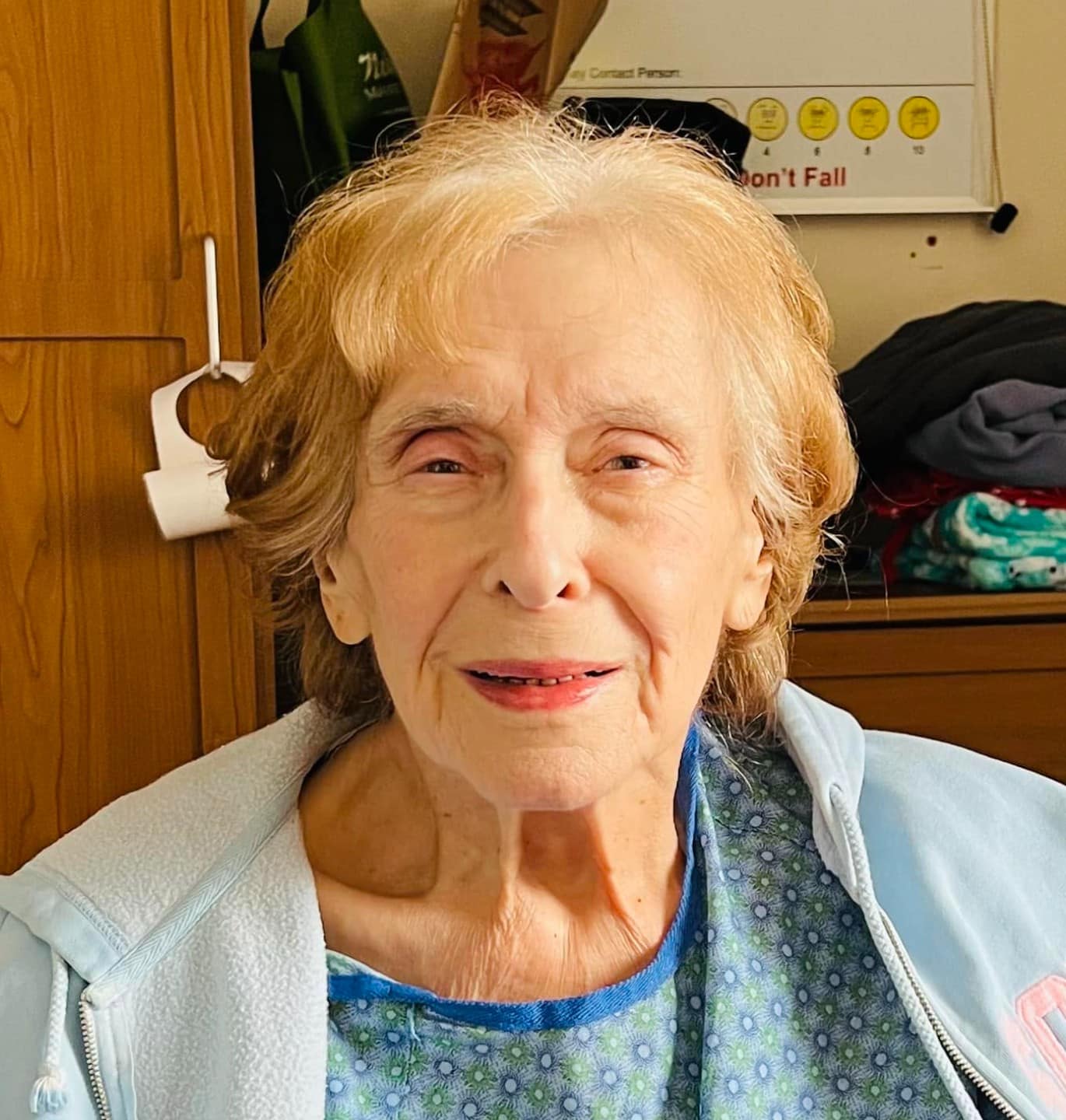
Most days I restored her into the woman she insisted on being. But there is one photograph from that time that is not like the others. Soft eyes. Her hair uncolored — silver, and soft. The face completely unguarded.
She hated that her hair wasn’t colored. I loved it. Because the uncolored, undefended mother was the one I’d spent my whole life reaching for and rarely got to meet. In that picture the armor is finally down, and there she is — the mom I always dreamed of. And I was the one holding the camera when it happened. Of course I was.
What she was saying the whole time
She couldn’t give me the words. So she gave me the sick-day, the bell, the Vicks, the iron. The chips held safe at the blackjack table. Let’s go home while you’re ahead. A silly face in a silent pew. An elf hat with a bell. A puppy held up to her cheek.
It turns out the sick-day was a whole language — one I’m fluent in, one I speak to myself now, one I carry into every dog I help and every developing being I’ve ever tried to keep safe. She taught me that the body in distress is where love gets to land. That may be the most important thing she ever managed to say, and she said it in Vicks and Jell-O and a hot iron, because that was the tongue she had.
I got the best of my mother when I was down. She came when I rang. She always came for the hard parts — as a child and as a grown woman, past eight years of silence, all the way to the end.
She’s not in the corner anymore.
But I have the words now. That’s what this is. I’m finishing her sentence.
And here is the last thing, the thing that undid me on the couch this month:
the puppy in that photo — the one held up to her cheek, the one who lit up her whole face — is the same dog lying against my leg right now, keeping watch while I mend. Nala met my mother. Nala was the clean venue in those last chapters, the little one who let us be simply, joyfully together when nothing else could.
And now she’s grown, and she’s tending me — doing the exact thing my mother did on every sick-day of my childhood. Be near the down human. Don’t move.
Bell, to mom, to Nala. The same post, held across a lifetime of love — some of it human, some of it fur.
I miss my mom.
And she’s all the way here.